
A playable silhouette
Supported body families give the creature a clear shape that can move, hatch and take part in the adventure.
CREATURE ENGINE // LIVING PROFILES
Every hatch begins with a structured identity: a body family, colour, markings, nature, affinity, potential and the chance of a rare change. Those choices shape how the creature looks and who it can become in the story.
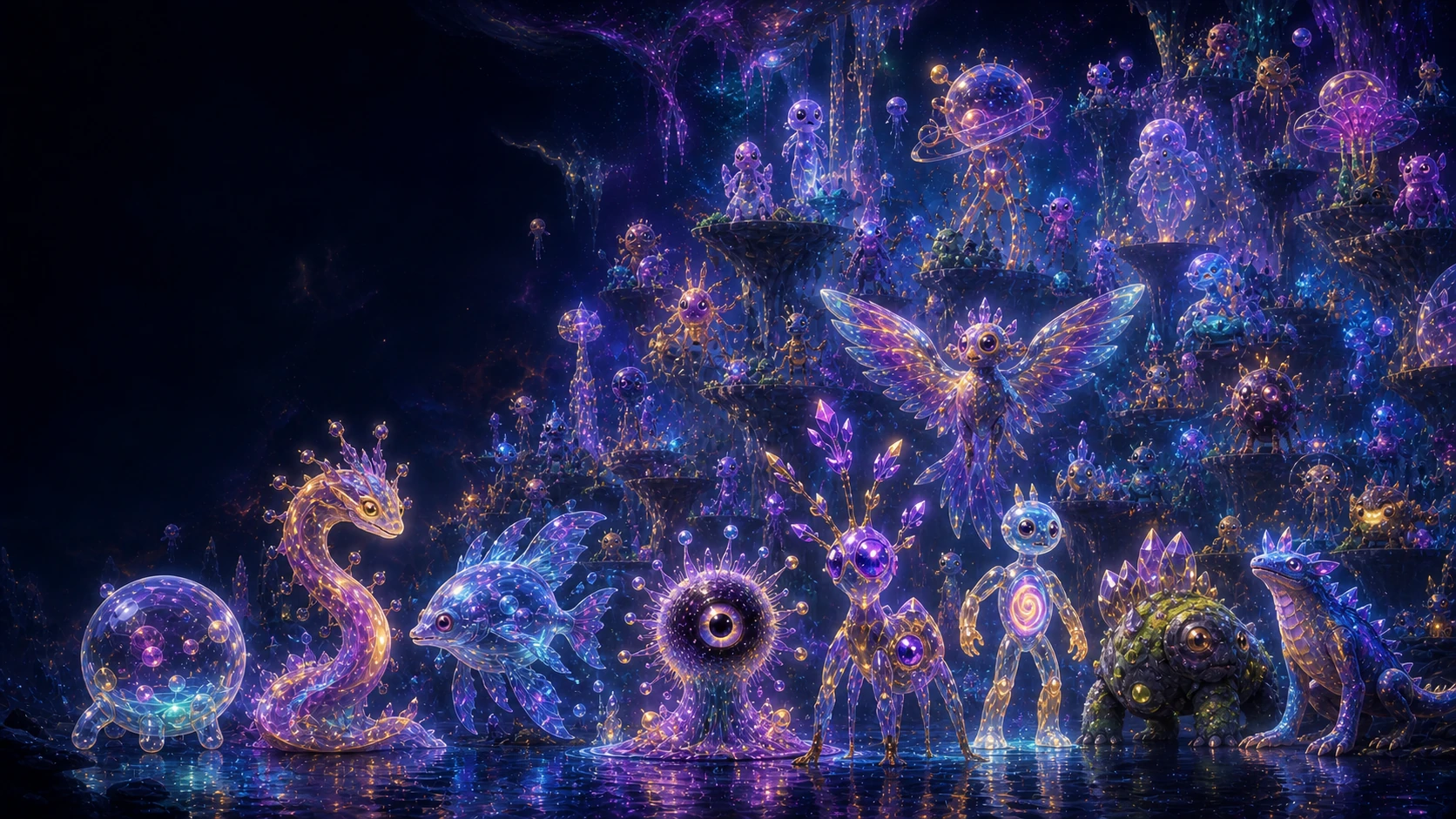
Honest boundary: the artwork shows the wider imagined universe. It does not claim that every pictured form is already a game sprite.
WHAT THE ENGINE CAN CHANGE
The current system combines visible form with personality and story potential. It can suggest something fluid, radial, crystalline, weather-born or gravity-folded while still using a shape the browser game can animate.
Supported body families give the creature a clear shape that can move, hatch and take part in the adventure.
Eye patterns, circuit traces, floating parts and unusual features can change how an organism appears to notice its realm.
Crystal, mist, living light, void patches, scales and other traits let one form feel like a very different kind of life.
Curious, wise, playful, gentle or energetic traits give the hatch meaning beyond appearance.
Moon, star, crystal, nebula and Void affinities connect the creature to forces in the wider story.
Mutations can create less expected combinations while keeping a profile the game can save and understand.
Why the old sprite gallery is gone: its files were real, but the tiny isolated exports did not help a person understand the game or its creatures. They have been withdrawn until stronger gameplay moments can be captured.
HOW A HATCH BEGINS
The same identity can guide the pixel creature in the browser game and any optional living portrait created later. The pixel form remains the trusted game record.
The engine selects from supported species signatures and body plans so the result can still move and read clearly in the game.
Colours, markings, eyes and visual traits combine to make the creature feel specific without promising impossible global uniqueness.
Personality, affinity, rarity and potential give the identity meaning beyond a cosmetic skin.
Mutations allow unexpected combinations while staying connected to a profile the game can save and understand.
The creature hatches at the Wanderer-77 crash site, travels through six realms, takes part in battles and helps give Project Beacon its meaning. The same structured identity can remain with the player as the story moves forward.
Why this matters: the creature is part of the game’s systems and story, not just an image made for a gallery.
See what the player actually does →ALIEN, NOT JUST ANIMAL
The creature universe can imagine organisms shaped by their environment while keeping a playable silhouette underneath.
Yes. A supported game shape can be imagined as a flowing membrane, a radial light-being, a gravity-folded organism or something made from crystal, weather or memory.
No. Marketing artwork explores the wider universe. The actual browser creature must still fit the movement, animation and collision shapes supported by the current game.
No. The pixel creature is the main identity and the game keeps working without generated media. A private Living Portrait or Creature Story Scene uses fictional creature details, not the player’s name, age range, location, words, photograph or voice.
No. The game may create responsive and memorable moments, but Mythical Void does not describe its creatures as sentient or conscious.
YOUR CREATURE IS WAITING
Play free in your browser. No download or account is needed to begin.